Skip to content
VedicSpaceVedhaśālā

← Vedic rituals

Ancestral rites · pind daanPind daan for your ancestors, at all four tirthas, in one seva.

Gaya, Varanasi, Prayagraj and Haridwar. Named purohits perform the rite in your family’s name and gotra. You receive proof from each place.

Daughters, sons, wives — anyone may honour their ancestors. All are welcome.

What it is

What is pind daan?

Pind daan is the offering of pinda — balls of cooked rice, barley flour and sesame — with water and mantras; the tradition holds that it is for the peace of departed ancestors. It is part of shraddha. The names and gotra of the ancestors are spoken in the sankalp.

The four tirthas

The four tirthas

Gaya

The tirtha the tradition names first for pind daan, on the banks of the Falgu.

Gaya is the place the tradition names first for offerings to ancestors. The rite is done at the Falgu river and around the Vishnupad temple, and the Akshayavat is part of the traditional round.

Families come to Gaya to offer pinda for their pitru — father, mother and the forefathers on both sides — with their names and gotra spoken in the sankalp.

  • Falgu river
  • Vishnupad Temple
  • Akshayavat

Varanasi

Kashi, on the Ganga — where shraddha is offered on the ghats.

Kashi is the city of moksha in the tradition, and shraddha is offered on the Ganga ghats. Many families take up the rites in Varanasi and then continue to Gaya.

Pishach Mochan Kund is the place traditionally associated with tripindi shraddha.

  • Ganga ghats
  • Pishach Mochan Kund

Prayagraj

The Triveni Sangam, where the Ganga and Yamuna meet.

Prayagraj is called Tirtharaj, the king of pilgrimage places. Offerings to ancestors are made at the Triveni Sangam, where the Ganga and Yamuna meet — and, in tradition, the invisible Saraswati.

  • Triveni Sangam

Haridwar

Where the Ganga leaves the mountains — Narayani Shila and Kushavarta Ghat.

At Haridwar, shraddha is offered at Kushavarta Ghat, and the Narayani Shila temple is the place traditionally associated with pind daan here.

  • Kushavarta Ghat
  • Narayani Shila
Price

One price, by the day.

₹10,001 a day

For the whole day, however many purohits take part. The purohits’ dakshina and all materials are included; nothing is charged on top.

You choose the number of days when you reserve. The total is the number of days times ₹10,001, and we confirm it with you before you pay.

The full roster is being prepared. Each purohit is listed here by name and city, with their consent, before bookings open.

How it works

How it works

  1. Reserve. Tell us your ancestors’ names, your gotra, which seva you choose and for how many days.
  2. We confirm on WhatsApp. A person from our team reads your details and the total back to you, then shares the payment step.
  3. The rite is performed at each place in your family’s name, on a date we tell you in advance.
  4. You receive proof — photo or video from each place, and the sankalp as recorded.

How we work

One Vedic process

Our ritual

One Vedic process, performed the same way at every place and by every purohit.

Vedic mantras only

Every mantra used in the rite is Vedic. We do not use local or folk mantras in place of the Vedic ones. Our purohits are trained in the Vedas, and they follow the Shankaracharya paddhati (method) for the puja.

The same process, whatever the purohit’s region

Our purohits come from Maharashtra, South India and North India. If the process is Vedic, it is the same process. The differences people often notice between regions were mostly differences of language, not of rite. Our purohits speak their own language, Sanskrit and English fluently, so a family can follow what is being done and why.

At least two purohits at the pind daan

The pind daan always has at least two purohits. One purohit only chants, so the flow of the mantra is never broken. The other assists the yajamana — guiding the family through each step. One person doing both would disturb the chanting.

Three forms of puja

Pujas are performed in the panchopachara (five-fold), dashopachara (ten-fold) or shodashopachara (sixteen-fold) form, according to the rite.

Vessels and materials

The deities and the patras are set out in silver for most pujas; where a puja calls for copper or brass, those are used. Organic materials are used in the rite.

The sankalp, in your ancestors’ names

You hear the sankalp spoken with your ancestors’ names in it. The names are read back to you in writing first, so a name spelt wrongly is not spoken wrongly.

For the yajamana

A yajamana comes to the rite as a yajamana — with humility, setting aside title and position. We treat every family the same, and we ask that the purohit be treated with the respect due to a guru. The rite asks for forgiveness — of others and of oneself — and we do not change it to suit anyone’s rank.

These are the standards our purohits are held to. Photos of the vessels and the purohits’ own introductions are on the purohits page as they are added.

Our purohits

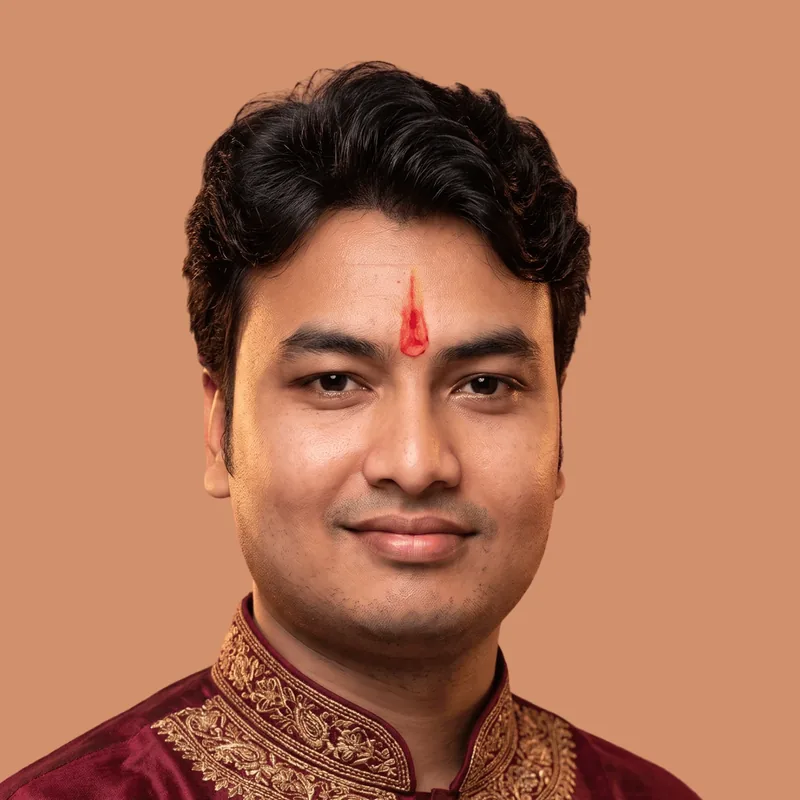
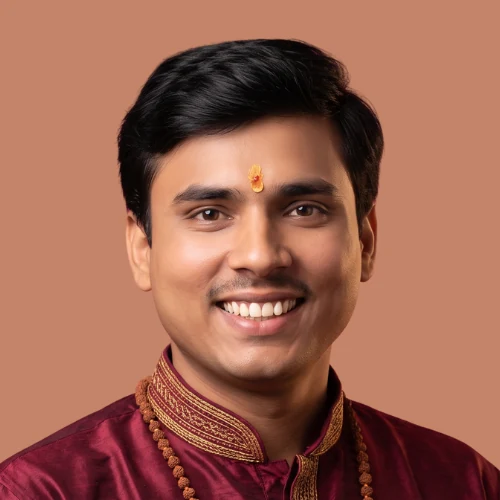
Two of our purohits are introduced here by name: Acharya Kuldeep Awasthi, a Vedic scholar and teacher, and Pt. Brajesh Maharaj, a scholar of karmakāṇḍa — the performance of Vedic rites. Both studied at Maharishi Vedic Vigyan Vishwa Vidyapeetham, and both spent years in the USA on visas marked “Vedic pandit”. The visas are shown below, with personal numbers hidden.

Acharya Kuldeep Awasthi

Who is Acharya Kuldeep Awasthi?

Vedic scholar and teacher

Acharya Kuldeep Awasthi is a Vedic scholar and teacher with 18 years in Vedic learning, Sanskrit and the traditional teachings of Sanātana Dharma. He received all his education at Maharishi Vedic Vigyan Vishwa Vidyapeetham, where he studied the Vedas and the many subjects of India’s knowledge tradition in depth.

He spent three years in the USA, teaching the Vedāṅgas — the six limbs of Vedic study — to American students with the help of an interpreter. That time strengthened his resolve to carry India’s ancient Vedic tradition to people of every cultural background.

He knows Sanskrit, Hindi and Awadhi well. His hold on Sanskrit lets him study the ancient texts and understand their teaching; in Hindi and Awadhi he can pass traditional Vedic knowledge on to people simply, naturally and faithfully.

With deep respect for the guru–śiṣya tradition and the principles of Sanātana Dharma, his aim is to preserve the knowledge of the Vedas and Vedāṅgas, to spread it, and to hand it on to the generations to come.

Trained at
Maharishi Vedic Vigyan Vishwa Vidyapeetham
Experience
18 years — Vedic learning, Sanskrit and Sanātana Dharma
Languages
Sanskrit, Hindi, Awadhi
In the USA
June 2010 to June 2013 (see the visa)
Pt. Brajesh Maharaj

Who is Pt. Brajesh Maharaj?

Karmakāṇḍa scholar

Pt. Brajesh Maharaj is an experienced scholar of karmakāṇḍa and Vedic rites, with more than 15 years in this work. He completed his education at Maharishi Vedic Vigyan Vishwa Vidyapeetham, where he studied the Vedic traditions and India’s spiritual knowledge.

By his own account he has taken part in more than 1,008 yajñas. That experience of many different Vedic rites has given him a working understanding of the yajña traditions, of ritual procedure, and of how karmakāṇḍa is carried out in practice.

With respect for the ancient traditions of Sanātana Dharma, Vedic discipline and the guru–śiṣya tradition, he is dedicated to completing every rite by its traditional method, with devotion. His aim is to preserve the authentic traditions of Vedic karmakāṇḍa and to carry India’s spiritual heritage forward through yajña and ritual.

Trained at
Maharishi Vedic Vigyan Vishwa Vidyapeetham
Experience
More than 15 years — karmakāṇḍa and Vedic rites
Yajñas
More than 1,008, by his own account
In the USA
September 2009 to September 2011 (see the visa)

What do their US visas show?

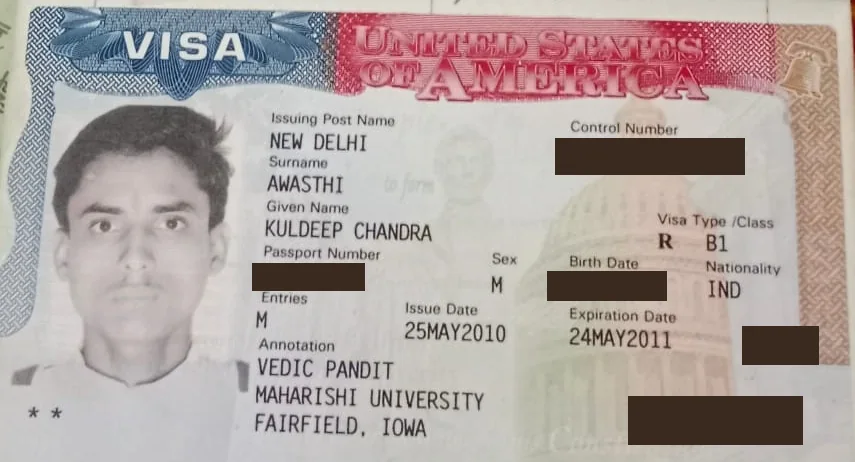
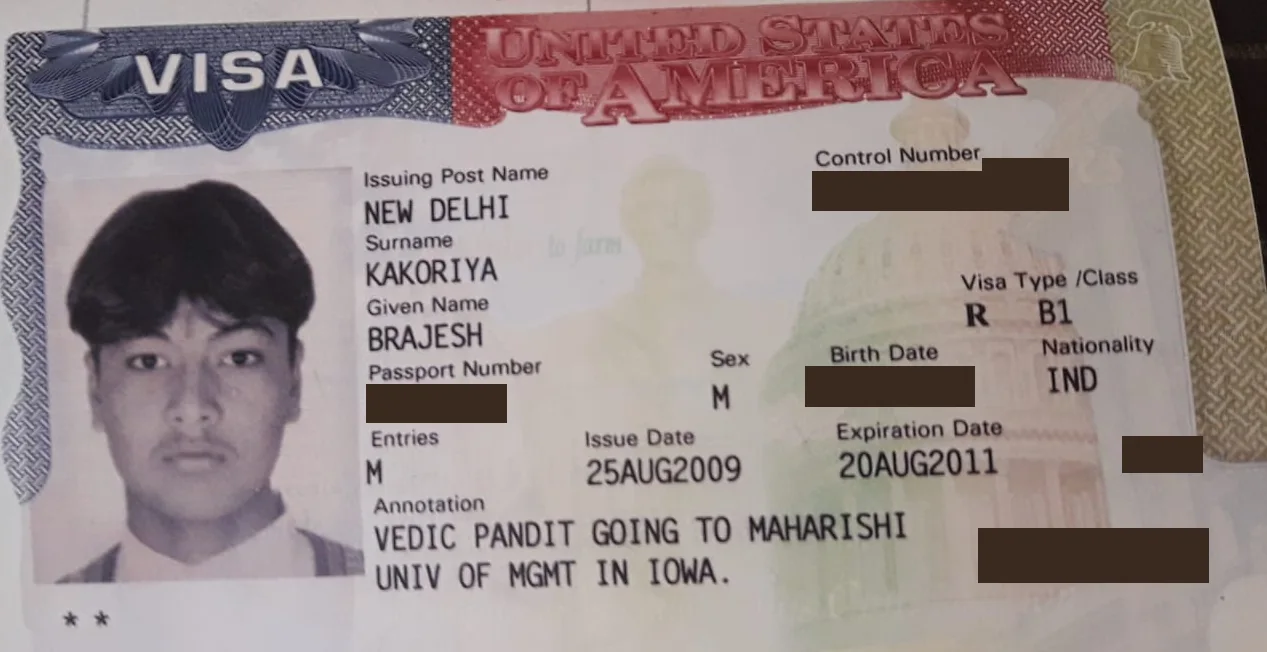
Both men went to the USA on B-1 visas issued by the US Embassy in New Delhi, and each visa carries a printed note of the purpose of the journey: “Vedic pandit”. The pages are shown as they are, with passport numbers, birth dates and other personal numbers hidden.

US visa of Acharya Kuldeep Awasthi, type B-1, with the printed annotation “VEDIC PANDIT / MAHARISHI UNIVERSITY / FAIRFIELD, IOWA”. Personal numbers are blacked out.Personal numbers hidden
Acharya Kuldeep Awasthi’s US visa, type B-1, issued in New Delhi in May 2010. Printed annotation: “VEDIC PANDIT / MAHARISHI UNIVERSITY / FAIRFIELD, IOWA”.
  1. May 2010 — Visa issued
  2. June 2010 — Entered the USA
  3. June 2013 — Back in India

3 years in the USA on this visa: June 2010 to June 2013, by the entry and exit stamps in his passport.

US visa of Pt. Brajesh Maharaj, type B-1, with the printed annotation “VEDIC PANDIT GOING TO MAHARISHI UNIV OF MGMT IN IOWA”. Personal numbers are blacked out.Personal numbers hidden
Pt. Brajesh Maharaj’s US visa, type B-1, issued in New Delhi in August 2009. Printed annotation: “VEDIC PANDIT GOING TO MAHARISHI UNIV OF MGMT IN IOWA”.
  1. August 2009 — Visa issued
  2. September 2009 — Entered the USA
  3. September 2011 — Back in India

2 years in the USA on this visa: September 2009 to September 2011, by the entry and exit stamps in his passport.

Why show visas?

Because we did not write them. Each visa was issued by the US Embassy in New Delhi, and its printed note — “Vedic pandit” — is the embassy’s wording, not ours. A visa is permission to travel; it is not a recommendation of any person or service.

How we choose and check them

  • Each purohit is a Vedic scholar registered with us, trained in the Maharishi tradition.
  • The rites follow the Shankaracharya paddhati (method) — the rules are those of that tradition.
  • Every one is interviewed in person before joining.
  • We check mantra pronunciation ourselves, at random, from time to time.
  • We ask that each purohit practises mantra chanting for at least two to three hours every day, as a way of life.

For the pind daan itself there are 51 or 101 purohits, as you choose.

All our purohits, by city

The full roster is being prepared. Each purohit is listed here by name and city, with their consent, before bookings open.

How we work

Plainly: what happens, who does it, and what we do not claim.

What happens

  1. A person from our team confirms your details with you on WhatsApp before any payment.
  2. Your sankalp is made in your family’s name and gotra, with each ancestor named as you gave them.
  3. Purohits perform the rite at each of the four places on your family’s behalf. You are not physically present.
  4. You receive a photo or video from each place, and the sankalp as recorded.

Who performs it

The purohits are real people. Two of them, Acharya Kuldeep Awasthi and Pt. Brajesh Maharaj, are introduced by name on the purohits page, with their training and their US visas. The full list, by name and city, is published there with each person’s consent before we take bookings.

What we do not claim

  • We do not promise any worldly or spiritual result — health, wealth, marriage or otherwise.
  • We do not say this replaces a family priest or your own elders’ guidance. Traditions differ on whether the rite may be done on someone’s behalf; please ask your elders if you are unsure.
  • We do not message people who have not asked us to.

Your information

Your ancestors’ names and your gotra are personal information. We use them only for your sankalp and to contact you, and we delete them when you ask. See privacy.

Reserve your family’s seva

Tell us who the rite is for. No payment is taken on this page. We will never ask for a bank PIN, a card OTP or a password, and we are not connected with any temple or government body.

We will confirm with you on this number before any payment.

Seva

Not sure? Leave it at 1. We tell you how many days your seva takes, and agree it with you, before any payment. ₹10,001 a day, for the whole day, however many purohits take part. The purohits’ dakshina and all the materials for the rite are included; nothing is charged on top.

Optional now; we will confirm it with you.

One per line, with the relation (for example: father, paternal grandfather).

Next you will see your details written out to check. Nothing is sent or paid yet.

Questions families ask

I cannot travel. Can the rite be done for my family?

Yes, in the form we offer: purohits perform the rite on your family’s behalf at each place, after a sankalp made in your family’s name and gotra. You are not physically present. Whether this is right for your family is your decision, and your own family priest or elders may hold their own view — we would rather you ask them than be unsure.

What do I receive?

A written confirmation of the sankalp as recorded, and photo or video from each place. The exact form and delivery time are stated on the How we work page once the purohits at each place are confirmed.

What does the price include?

The price is ₹10,001 a day, for the whole day, however many purohits take part. It includes the purohits’ dakshina and all materials for the rite; nothing is charged on top. You choose the number of days when you reserve, and we confirm the total with you before you pay.

What is the difference between the two seva options?

Both are charged the same way, at ₹10,001 a day. The Vedic Purohit Seva is performed by 51 Vedic purohits; the Maha Seva by 101 purohits.

How do I know this is genuine?

We are a private seva service. We are not connected with any temple, the Vishnupad committee or any government body, and we never say we are. We will never ask you for a bank PIN, a card OTP or your password. Before you pay, you should be able to see who the purohits at each place are, what is included in the price, and what you will receive afterwards — if any of these is missing on our pages, ask us before paying.

How is my family’s information used?

Only to prepare and perform your sankalp and to contact you about your booking. You can ask us to delete it at any time. See the privacy page.

All rituals

About this page

Book a Vedic puja performed in your family's name, anywhere in the world. Pind daan at Gaya, Varanasi, Prayagraj and Haridwar now; more rites, incl. dosha remedies, to come.